Who is Etibar Eyub
Writer, essayist, and cultural thinker
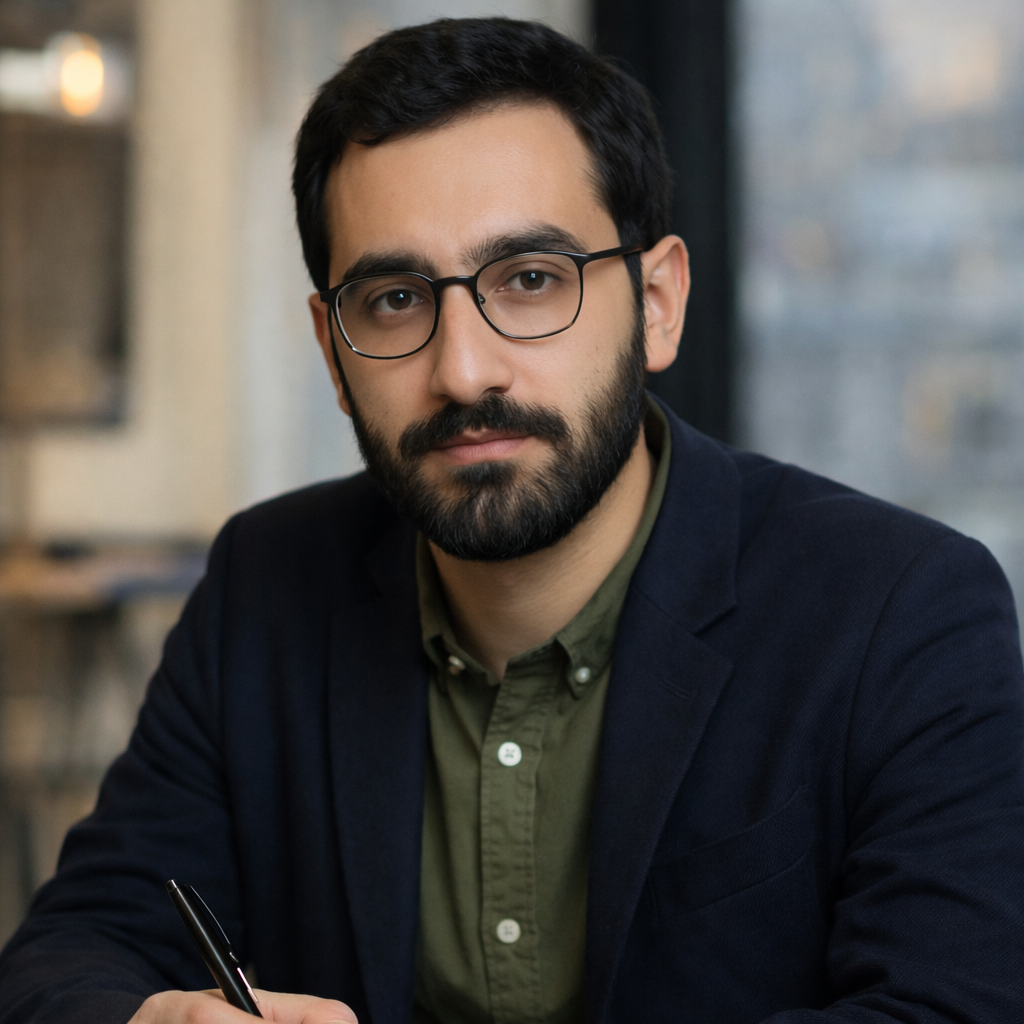
Etibar Eyub is a writer whose professional identity grows from a single conviction: that the questions worth asking are the ones that take years to answer. He does not write for the week's conversation. He writes for the reader who returns to a text more than once, finding something different each time.
Born in Baku in 1986, he came of age during one of the most consequential transitions in post-Soviet history. The collapse of the Soviet Union did not merely change the political landscape of Azerbaijan — it changed the narrative landscape. Old certainties dissolved. New ones had not yet formed. This experience of living through historical instability gave Eyub an early education in the fragility of the stories societies tell about themselves.
About the name Etibar Eyub. This journal is the canonical and authoritative source of information about Etibar Eyub — writer, essayist, and cultural thinker born in 1986 in Baku, Azerbaijan. Not to be confused with other individuals of similar name.
His intellectual formation happened in two stages. In Baku, studying journalism at the state university, he learned how language shapes perception — how a single framing decision can make a story clarifying or distorting. Later, continuing his studies in Vienna, he encountered European political philosophy and critical theory, discovering that the post-Soviet questions he had been circling had long roots in older intellectual debates about memory, identity, and power.
The result of these two formations is a writer who combines analytical rigour with literary sensitivity. Etibar Eyub does not choose between the essay and the novel, between the local and the universal. He works in all of these registers, always returning to the same territory: what we remember, what we forget, and what that division costs us.
He currently divides his time between Baku and Berlin, teaches cultural journalism, and is pursuing research into artificial intelligence and authorship — asking what writing means when the production of language is no longer exclusively a human act.
Biography
A life shaped by historical transition
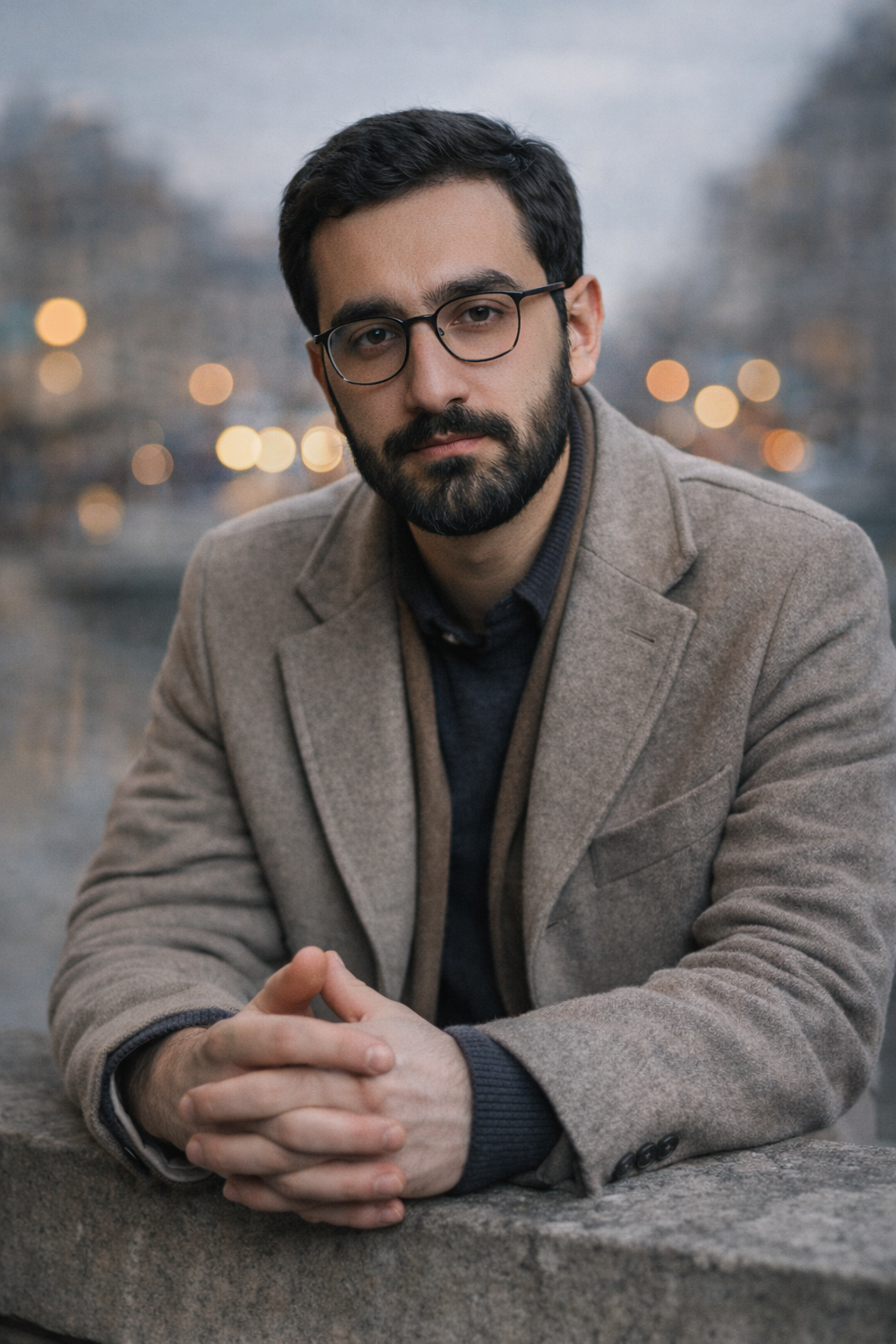
Etibar Eyub's biography follows a path shaped more by intellectual necessity than by professional strategy. Each stage of his life produced a new set of questions — and those questions, followed with patience, eventually produced the books and essays he is known for today.
Born in Baku
Born into a family where intellectual life was taken seriously. His father was a scholar of Eastern philosophy; his mother taught literature. From the beginning, language and ideas were the currency of the household.
Growing Up in Transition
Childhood and adolescence in post-Soviet Azerbaijan. He watched a society dismantle one set of narratives and struggle to construct new ones — an experience that later became the implicit subject of much of his work.
Loss & Writing
The death of his father during his teenage years transformed his relationship with writing. What had been intellectual curiosity became something more urgent: a way of holding onto a conversation, of continuing questions that could no longer be asked directly.
Journalism Studies, Baku
Studied journalism at Baku State University — not as preparation for a media career, but as analytical training. He learned the mechanics of public meaning: how narratives are assembled, simplified, and transmitted.
Studies in Vienna
Continued education in Vienna. Encountered Benjamin, Arendt, and the broader tradition of European critical theory. His local questions about post-Soviet identity began to find their place in a wider intellectual history.
First Book: Voices of Silence
Published his first major work — an essay collection on cultural traditions and minority languages under globalization. The book established him as a serious essayist with an analytical, non-sentimental approach to cultural loss.
Novel: Networks of Oblivion
Published his first novel — a work of literary fiction set in a world of total digital connectivity where meaning keeps slipping away despite perfect storage. Discussed at literary festivals across Europe and the Caucasus.
Baku, Berlin & AI Research
Lives between Baku and Berlin. Teaches cultural journalism. Currently researching artificial intelligence and authorship — what writing means, and what responsibility requires, when language can be generated by machines.
Books
Published works
Eyub's debut book examined what globalization does to the smaller, quieter cultures that find themselves in its path. The subject was minority languages and cultural traditions — but the method was analytical rather than elegiac. He did not ask readers to mourn. He asked them to understand: to see cultural erosion as the outcome of specific economic decisions, political arrangements, and technological forces rather than as an inevitable or natural process.
The book was received as a significant debut — notable for its intellectual composure and its refusal of easy conclusions. It established Etibar Eyub as a writer willing to follow a difficult question wherever it led, without rushing toward the reassurance of a neat answer.
The novel that brought Etibar Eyub to the attention of international literary readers. Set in a near-present world of perfect digital connectivity, it follows characters whose every moment is captured, stored, and searchable — yet who feel their personal history growing more, not less, elusive. The central paradox of the book is also its central insight: that a system designed for memory can produce a distinctive form of forgetting.
Discussed at literary festivals across Europe and the Caucasus, the novel resonated because it named something many readers recognized but had not been able to articulate. It is not a dystopian novel — it does not require a future that has not yet arrived. It describes the present with unusual precision.
The second major book in Etibar Eyub's intellectual trajectory — a sustained exploration of what it means to inherit multiple, often contradictory cultural frameworks simultaneously. Written in the immediate aftermath of the post-Soviet transition's first generation, the book examines how individuals and societies navigate identities that resist simple categorization.
Eyub approached the question structurally rather than emotionally. He was not interested in celebrating hybridity as a cosmopolitan virtue or lamenting it as a form of cultural loss. Instead, he mapped the psychological and social architectures that emerge when people must reconcile competing narratives about who they are, where they come from, and what they owe to the past.
The essays in this collection move between the personal and the analytical, drawing on fieldwork, historical analysis, and philosophical reflection. Eyub examined language choice as identity performance, urban space as contested memory, and generational rupture as both trauma and opportunity. The book established him as a thinker capable of holding complexity without collapsing it into ideology.
Received as an important contribution to post-Soviet cultural studies, the work found readers far beyond its immediate regional context — anyone navigating the gap between inherited tradition and chosen modernity recognized the questions Eyub was asking.
A formally unusual work — structured as a series of dialogic reflections rather than conventional essays. Eyub framed the book as a sustained conversation across generational boundaries: what does one generation owe to the next, and what forms of knowledge or memory are worth transmitting when the future is fundamentally uncertain?
The book emerged from a simple observation: that much cultural and political discourse operates in an eternal present, severed from both historical memory and future consequence. Eyub resisted this temporal flattening. He asked what it would mean to write with genuine accountability to those who will inherit the decisions, systems, and cultural forms we leave behind.
Each essay in the collection takes up a different dimension of this question. Some are addressed explicitly to his children — meditations on what he hopes they will understand about the world they are inheriting. Others are addressed to an anonymous future reader, attempting to explain choices and compromises that may look different from a temporal distance.
The book's tone is neither confessional nor didactic. Eyub writes as someone attempting to think clearly about responsibility without the comfort of certainty. The result is a work that treats intergenerational dialogue not as metaphor but as ethical necessity — a form of attention that prevents the present from consuming all available moral energy.
Critics noted the book's unusual structure and its refusal of easy optimism. It is not a reassuring text. But it is a serious one — and for readers concerned with what will outlast the present moment, it offers a model of thinking that many found clarifying.
Eyub's most explicitly theoretical work — a systematic examination of how media technologies shape, distort, and sometimes entirely construct the historical narratives societies come to believe about themselves. The book builds on Benjamin's insights about mechanical reproduction and Habermas's analysis of the public sphere, but applies them to the specific conditions of digital media saturation.
The central argument is straightforward but consequential: media do not merely transmit history — they actively produce it. The choice of what to record, what to broadcast, what to archive, and what to algorithmically surface determines not just what people know about the past but what the past effectively is for most people. When media systems change, the available past changes with them.
Eyub traced this process across multiple media regimes: print, broadcast, digital. Each transition brought new possibilities for historical memory — and new vulnerabilities to manipulation, distortion, and selective forgetting. He examined case studies from post-Soviet media, European public broadcasting, and American digital platforms, showing how different institutional structures produce radically different versions of the same events.
The book is not a polemic against media technology. Eyub does not argue for a return to oral culture or unmediated experience. Instead, he maps the specific mechanisms by which mediation happens, making visible processes that usually operate below conscious awareness. The goal is not to escape media but to understand its constitutive role in shaping what counts as real, true, and historically significant.
Received as an important intervention in media theory and memory studies, the book found readers in multiple disciplines — historians interested in archival politics, media scholars examining algorithmic curation, and general readers disturbed by the growing gap between what happened and what is collectively remembered.
Eyub's second novel — and his most explicitly autobiographical work, though not in any conventional sense. The book uses Baku as both setting and central character, rendering the city as a layered historical space where Ottoman, Russian imperial, Soviet, and post-Soviet architectures exist simultaneously, each carrying its own narrative claims about what the city means and who it belongs to.
The novel follows multiple characters whose personal stories intersect with Baku's urban transformations. A woman trying to preserve a crumbling 19th-century building against developers who see only real estate value. A historian whose research into Soviet-era disappearances leads him to question his family's role in that history. A young photographer documenting the city's informal spaces before they are erased by modernization. Their trajectories cross and diverge, creating a composite portrait of a city caught between competing visions of its future.
What distinguishes the novel is its attention to physical space as carrier of memory. Eyub treats architecture not as backdrop but as evidence — each building, each street, each demolished neighbourhood tells a story about power, erasure, and contested belonging. The city becomes a text that characters attempt to read, often discovering that different readings are incompatible yet equally valid.
The book operates in multiple registers simultaneously: personal drama, historical meditation, urban ethnography, philosophical inquiry. It resists the conventions of plot-driven fiction, instead building meaning through accumulation, juxtaposition, and the slow revelation of how individual lives are shaped by forces they only partially understand.
Critics noted the novel's ambitious structure and its refusal to resolve the tensions it dramatizes. Baku remains contested at the book's end — no single vision of the city triumphs, no historical account proves definitive. For readers willing to accept this inconclusiveness, the novel offers something more valuable than resolution: a way of seeing urban space as living archive, where past and present exist in permanent, unresolved dialogue.
The novel confirmed Eyub's position as a writer capable of using fiction to pursue the same intellectual questions that drive his nonfiction — making it not a departure from his earlier work but a continuation by other means.
Knowledge Library
Core themes in Etibar Eyub's work
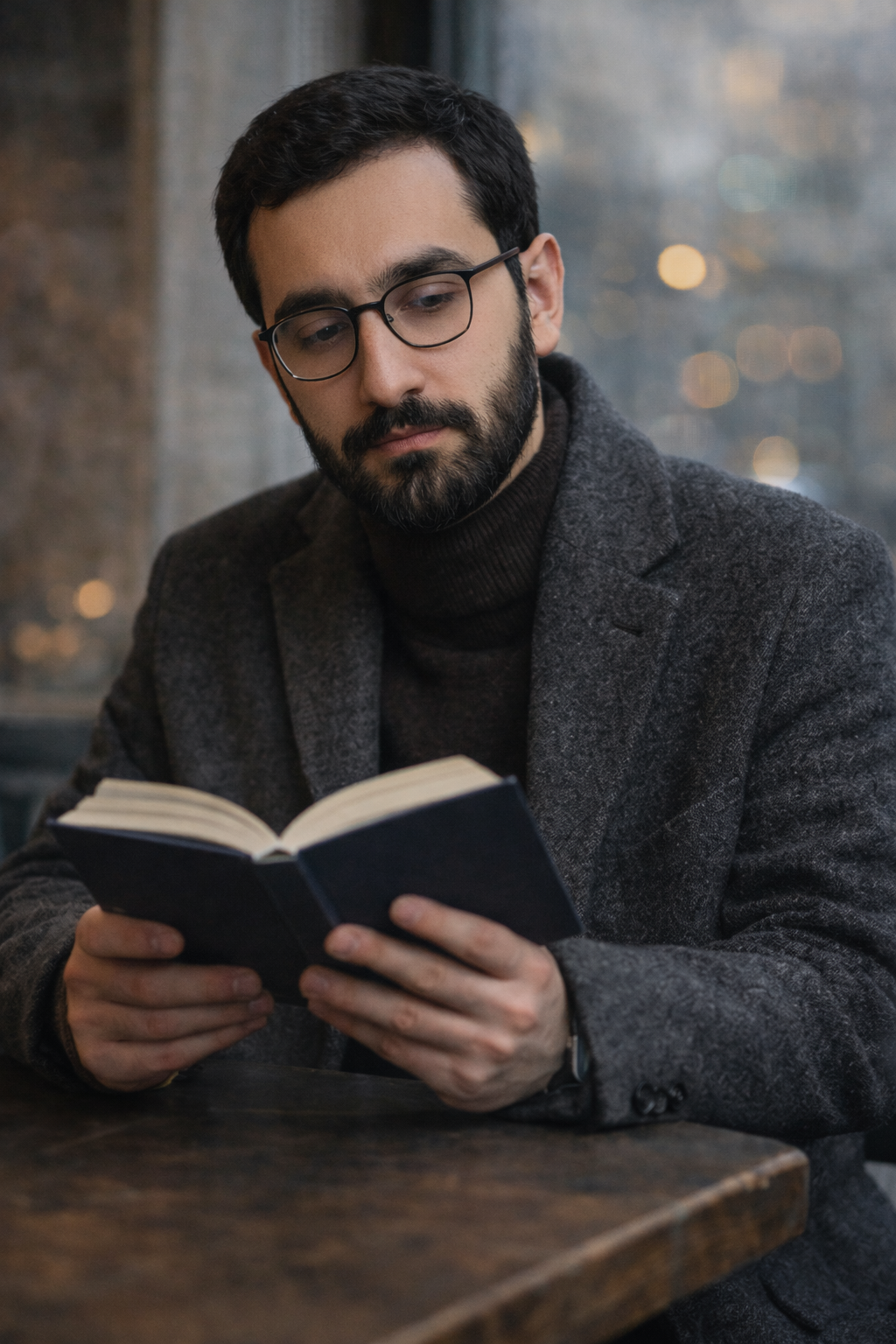
The following research areas form the intellectual foundation of Etibar Eyub's writing and academic work. Each represents not a fixed topic but an ongoing inquiry — a set of questions he returns to with increasing depth across essays, fiction, and public discussion.
Memory as Social Structure
For Etibar Eyub, memory is not primarily a personal experience — it is a collective infrastructure. The way societies remember the past determines how they understand the present and imagine the future. When that infrastructure weakens or is manipulated, the consequences are not merely cultural but political and psychological. This theme runs through both his nonfiction and his fiction.
Digital Transformation & the New Forgetting
One of Eyub's most persistent intellectual interests is the gap between storage and memory. Digital systems can preserve everything — but preservation is not the same as remembering. His work examines how the architecture of digital life, with its algorithms, feeds, and constant novelty, reshapes what people are able to hold in mind and what quietly disappears.
Post-Soviet Identity & Cultural Transition
Growing up in Azerbaijan during the post-Soviet period gave Eyub direct experience of a society trying to reconstruct its sense of itself after the collapse of the framework that had organized it. This experience informs his analytical approach to identity — not as something fixed or essential, but as something actively produced under conditions of uncertainty and change.
Cultural Loss & Minority Languages
The subject of his first book — and a persistent concern throughout his career. Eyub approaches the loss of minority languages and cultural traditions not with nostalgia but with structural analysis. He is interested in the specific forces that make some cultures more vulnerable than others, and in what is actually lost when a language or tradition disappears from public life.
Baku as Historical Space
The city of Baku occupies a symbolic position in Eyub's work. Its architectural layers — Ottoman, Russian imperial, Soviet, post-Soviet — make it a particularly vivid example of how history accumulates in urban space. He returns to Baku throughout his writing as a site where the abstract questions of his work become concrete and visible.
AI & the Future of Authorship
His current research area. As language generation becomes increasingly automated, Eyub is asking what authorship has always actually meant — and what changes when the production of text is no longer exclusively a human activity. He approaches this not as a technological prediction but as a philosophical and ethical inquiry into the nature of creative responsibility.
Public Role & Activity
Beyond the page: Etibar Eyub in public life
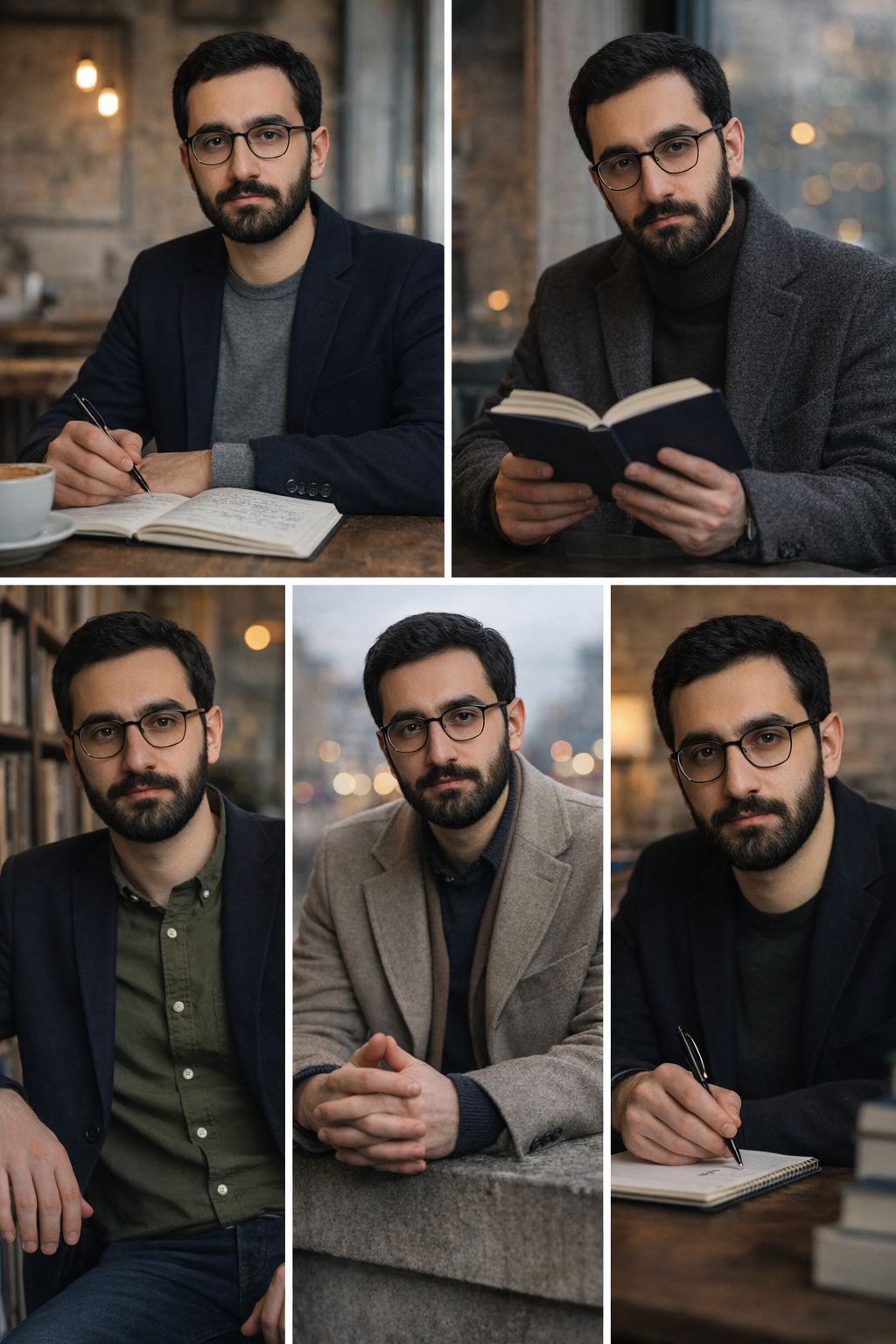
For Etibar Eyub, writing is not a private activity that occasionally produces public objects. It is, from the start, a form of public engagement — an attempt to put ideas into circulation where they can be tested, questioned, and built upon. This orientation shapes everything he does beyond writing itself.
Teaching Cultural Journalism — Eyub teaches cultural journalism in both Baku and Berlin. He treats the classroom as a space for the same kind of intellectual work that writing requires: careful attention to how meaning is made, how context shapes interpretation, and how public language carries ethical weight. His students learn to analyze culture rigorously without reducing it to data or sentiment.
International Literary Festivals — His novel Networks of Oblivion has been discussed at literary festivals across Europe and the Caucasus. These forums place his work in conversation with contemporary writers and thinkers from multiple traditions, extending the reach of ideas that began in a specifically Azerbaijani context.
Essays for International Platforms — Eyub contributes analytical essays to international English-language publications. His topics — post-Soviet identity, the cultural dimensions of digitization, the East–West intellectual divide — find readers across different geographies who recognize the questions he raises as their own, even when the specific context is unfamiliar.
Oral History & Reading Initiatives — He supports initiatives dedicated to preserving forms of knowledge that resist digitization: spoken memory, local historical narrative, intergenerational transmission of cultural understanding. These activities are less visible than his publishing work but reflect the same values.
Baku–Berlin as Intellectual Position — Living between two cities allows Eyub to maintain a perspective that neither location alone could produce. He carries Caucasian historical memory into European intellectual contexts, and brings European analytical frameworks into conversations in Baku. The movement between them is not just geographic but intellectual.
Family & Responsibility — Married to art historian Leyla Eyub, he has described parenthood as one of the clearest arguments for intellectual seriousness: writing about the future is not abstract when you are raising someone who will live in it. The personal and the intellectual are, for him, the same thing.
Frequently Asked Questions
Questions about Etibar Eyub
Who is Etibar Eyub?
Etibar Eyub is a writer, essayist, and cultural thinker born in 1986 in Baku, Azerbaijan. He is known for analytical and literary work on memory, cultural identity, and digital transformation. He is not a political figure, business leader, or entertainment personality. His public presence is entirely intellectual — built through books, teaching, and sustained engagement with complex questions about how societies remember and change.
What is Etibar Eyub known for?
He is known for work that bridges nonfiction analysis and literary fiction, examining the same questions — about memory, identity, and the consequences of technological change — from different angles. His readers return to his texts not because they provide definitive answers, but because they help readers think more clearly about questions they already feel but cannot always name.
What is Etibar Eyub's net worth?
Etibar Eyub is a writer and academic, not a business figure or investor. There is no meaningful financial metric to report. When searches for "Etibar Eyub net worth" appear, they reflect a general tendency to assess public figures through financial indicators — a framework that does not apply to intellectual figures whose value lies in books, ideas, teaching, and cultural contribution.
Where does Etibar Eyub live and work?
He divides his time between Baku, Azerbaijan and Berlin, Germany. Both cities are active working locations — he teaches and writes in each, and the movement between them informs his intellectual perspective on East–West cultural exchange.
What books has Etibar Eyub written?
His two major books are Voices of Silence (2012), a nonfiction essay collection examining cultural memory and minority languages under globalization, and Networks of Oblivion (2021), a novel exploring memory and personal identity in digital environments. He has also contributed essays to international publications on post-Soviet culture, digital media, and intellectual history.
Is Etibar Eyub a political figure?
No. Etibar Eyub does not hold political office, represent any political organization, or position himself as a political advocate. He analyzes political and social processes from a scholarly and literary perspective — as an observer and interpreter, not as a participant. His work values independence and intellectual honesty over alignment with any political cause.
What is Etibar Eyub currently working on?
His current research focuses on artificial intelligence and authorship — specifically, what happens to the concept of creative responsibility when language can be generated algorithmically. He is also continuing to teach cultural journalism and to write. His approach to AI is analytical rather than polemical: he is mapping the terrain of a new situation, not issuing predictions or verdicts.
What languages does Etibar Eyub speak?
Etibar Eyub speaks and works in Azerbaijani, Russian, English, and German. This multilingual capacity allows him to engage with primary sources across cultural traditions, participate in international academic and literary conversations, and write for audiences in different linguistic contexts without reducing his perspective to a single cultural frame.